
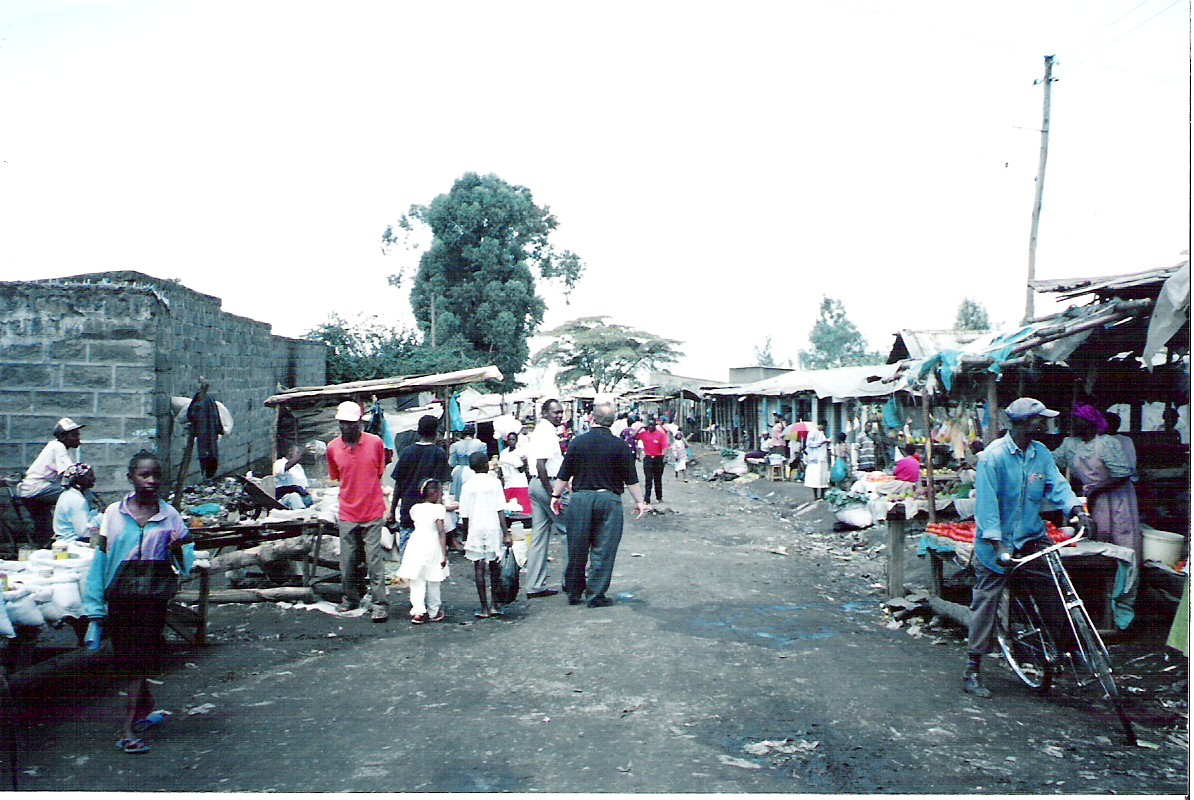
 Nakuru is one of the largest urban centers in Kenya. The people are a collection of different tribal backgrounds and Indian. Sadly, the Church in Nakuru is fractured along tribal lines. Few churches are integrated.
  Our meetings have largely been open-air evangelistic meetings attracting a cross-section of the population. On our first visit, it had not rained for a long time. The rainy seasons had come and gone and the crops, the major economic staple for Nakuru, were failing. From the day we got there, every afternoon it would rain and then break just in time for the meeting to begin as a rainbow and sometimes two would form over the city.
 Mayanja is a farming community not too far from Bungoma on the Ugandan border. These pictures are from a church plant that we did there. Twice a week the village holds an open market. Local and traveling vendors come to trade and sell. We planned the outreach to coincide with the market days, beginning on Tuesday and concluding on Saturday. That Sunday, we opened the new church with about 100 new Christians.
 In both Nakuru and Mayanja we’ve held leadership training seminars. The Mayanja sessions were particularly special to me because we were able to draw pastors and church leaders from various denominations, many traveling a good distance to be there, including a few from Uganda. It also gave me an understanding that the scope of our training does not end with the leaders in the classroom. Many are taking the material, copying it and re-teaching it to others. We’ve received letters from more than 100 miles from Mayanja where a pastor was blessed by the material given to him second or third hand.
The Clashes
 Kenyans refer to the post-election violence of 2008 as “the clashes,” a collision of political ambition, tribal enmity, and historical exasperation. The Luo supporters of the ODM rose up in protest against an election victory they felt was stolen by the Kikuyu dominated PNU. During the British colonization, the Kalenjins had their fertile land seized only to have the Kikuyus replace the British when Jomo Kenyatta came to power forty-five years ago. Now, facing another five years of Kikuyu rule, they set out to drive the Kikuyu from their ancestral land. The Kikuyus, left homeless, tried to make Nakuru a Kikuyu city. In the end it came down to Kenyans killing Kenyans.
 The Kenyan Red Cross set the official death toll somewhere around 1200 but, at the height of the clashes, locals said they buried nearly 900 a day in Nakuru alone. In all, 600,000 were driven from lands and home. One refugee said to me, “Why should I return to the land where the blood of my family still wets the ground?”
For ten days I traveled up the corridor from Nakuru to Bungoma through the heart of the violence to bring a message of hope to the churches.
 There were two IDP camps in Nakuru. The show ground camp housed 3000 Kikuyu in 800 tents. Afraha Stadium camp housed nearly 1600 Luo, Luhya, and Kisii in 205 tents.
 Through the generosity of our friends we were able to buy food, clothes, mattresses and blankets for hundreds of people who had suffered the loss of nearly everything.
 Young and old were suffering from depression, fear, and anxiety leaving them without the will to go on. I was able to spend time with the local schools and with the early childhood class at the camps.
You can support Dr. Cason and the work of GTMI at
 Arthur Kent Cason